
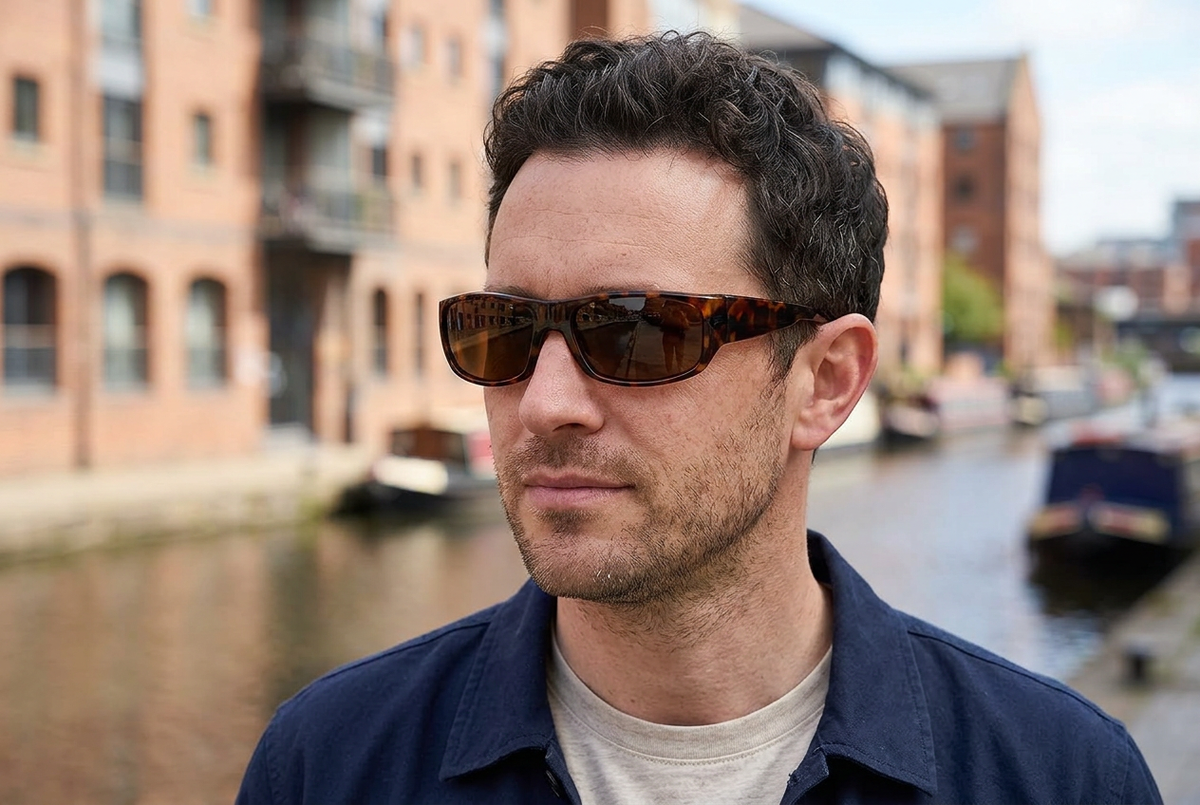
Two pairs of men’s sunglasses can have almost the same lens shape and still make completely different impressions. One draws a fine line around the eyes; the other gives the whole face a stronger outline.
That difference often gets reduced to metal versus plastic. But material, rim thickness and construction are separate things. A metal frame can be substantial, a non-metal frame can be slender, and a mixed-material design can combine elements of both.
For a Leeds day that takes you from a meeting near Wellington Place to an outdoor catch-up around Granary Wharf, choosing between them starts with how you want the pair to look and work. Explore the Missandtrendy men’s sunglasses collection with the comparisons below in mind.
The visual choice: an outline or a focal point?
A fine metal rim lets the lenses do more of the visual work. Beside a plain shirt or lightweight jacket, it can feel relatively unobtrusive even when the lens shape is distinctive.
A thicker rim makes the frame itself more prominent. A dark rectangular front introduces a defined line that can work well with a relaxed overshirt, a knit or a simple T-shirt.
Neither belongs exclusively to formal or casual clothes. A bold frame can sharpen tailoring; a fine rim can bring contrast to workwear. For men’s fashion sunglasses, choose the effect you enjoy rather than assuming a material comes with a dress code.
If you cannot decide, compare two designs with similar lens proportions. That helps you see whether it is the rim or the shape beneath it that you actually prefer.
The fitting choice: look at the bridge first
Some metal designs use separate adjustable nose pads. Many moulded frames use a fixed bridge, although construction varies. Check the particular pair rather than treating either feature as a rule for the whole category.
Adjustable pads offer scope for professional fitting, but they do not guarantee a suitable fit. A fixed bridge can sit comfortably when its contour suits you; the issue is the contact with your nose, not whether one system sounds more technical.
If your existing sunglasses slip, note where the bridge touches before choosing a replacement. Simply buying tighter temples or a smaller lens size may not address the cause.
Compare the stated bridge and overall dimensions with a comfortable pair, remembering that similar numbers can still sit differently. Seek professional help for adjustments rather than bending the frame yourself.
The hinge choice: flexibility is a feature, not a verdict
Spring hinges allow some outward movement of the temples beyond their normal opening position. That can accommodate movement and may help reduce a rigid feeling at the sides in some fits.
They do not make a narrow frame universally comfortable or guarantee durability. Standard hinges can also be an appropriate choice when the frame dimensions and shape suit you.
Read the hinge specification rather than trying to identify the mechanism from a metallic finish. Also consider temple length and the curve behind the ears, especially if you wear headphones or a cap.
Frame material does not settle the weight question either. Compare listed weights where available, but remember that bridge contact and weight distribution affect how a pair feels. A fine-looking frame is not automatically the lighter or more comfortable option.
Keep lens performance out of the material debate
A metal rim does not imply a particular lens, and a substantial front does not prove protection. Lens specifications deserve their own comparison.
Where a product lists TAC polarised lenses, TAC refers to triacetate cellulose used in the lens construction. Polarisation is the feature intended to reduce certain reflected glare. That can be useful outdoors, but it does not eliminate every reflection or make a lens suitable for every situation.
Check the stated UV protection, lens category and intended use separately. A mirrored surface, dark tint or TAC label is not a substitute for those details.
For an outdoor stop near the water at Granary Wharf, assess the actual conditions rather than choosing solely because water is nearby. Take sunglasses off whenever the tint makes it harder to see, and check screen readability with your chosen lenses.
Planning to relens? Compare the exact frame
If prescription lenses are part of your plan, neither metal nor a thicker rim wins automatically. Look for an explicit prescription-friendly or relensing statement, then ask an optician to assess the specific frame for your requirements.
Your prescription, the lens design, frame curvature and construction all help determine what is feasible. A design that works for one person’s lenses may not suit another’s needs.
Confirm the finished lens specifications with the provider. Replacement lenses do not automatically retain the original pair’s polarisation, tint or UV specification.
This conversation is worth having before buying a frame for relensing, rather than after discovering the shape you like cannot accommodate the lens solution you need.
City wear and sports use ask different questions
For everyday Leeds plans, appearance, appropriate lenses and comfortable fit may lead your decision. For running or cycling, men’s sports sunglasses need to be assessed against the specific activity and any equipment you wear.
Do not infer impact protection from a broad temple, flexible-looking material or wraparound shape. A fashion frame and activity-specific eyewear can look similar while having different intended uses.
Whichever construction you choose, follow its care instructions, use a suitable case and avoid treating either a metal or non-metal frame as indestructible.
Choose the construction that supports your preference
If you want a quiet outline, start with finer-rimmed designs. If you enjoy a defined frame, explore more substantial fronts. Then compare bridges, hinges, dimensions and lenses without letting the material name do all the deciding.
Browse men’s sunglasses at Missandtrendy for your own Leeds routine. The useful choice is not a winning material category; it is a particular pair whose look and specifications make sense for you.