
Ten seconds in a mirror can tell you whether you like a frame. They cannot tell you everything about wearing it for an afternoon. Men’s sunglasses that look right at first can reveal a slipping bridge or persistent temple pressure once you start moving.
Imagine setting off beside the Clyde, with a longer walk towards the Riverside Museum rather than a quick dash between buildings. The aim is not to buy sunglasses for one Glasgow landmark. It is to choose a pair you do not spend the whole route adjusting.
This guide takes a problem-solving approach to men’s sunglasses at Missandtrendy: identify what bothers you about your current pair, then compare features that address the actual issue.
Army-inspired style, without the full uniform
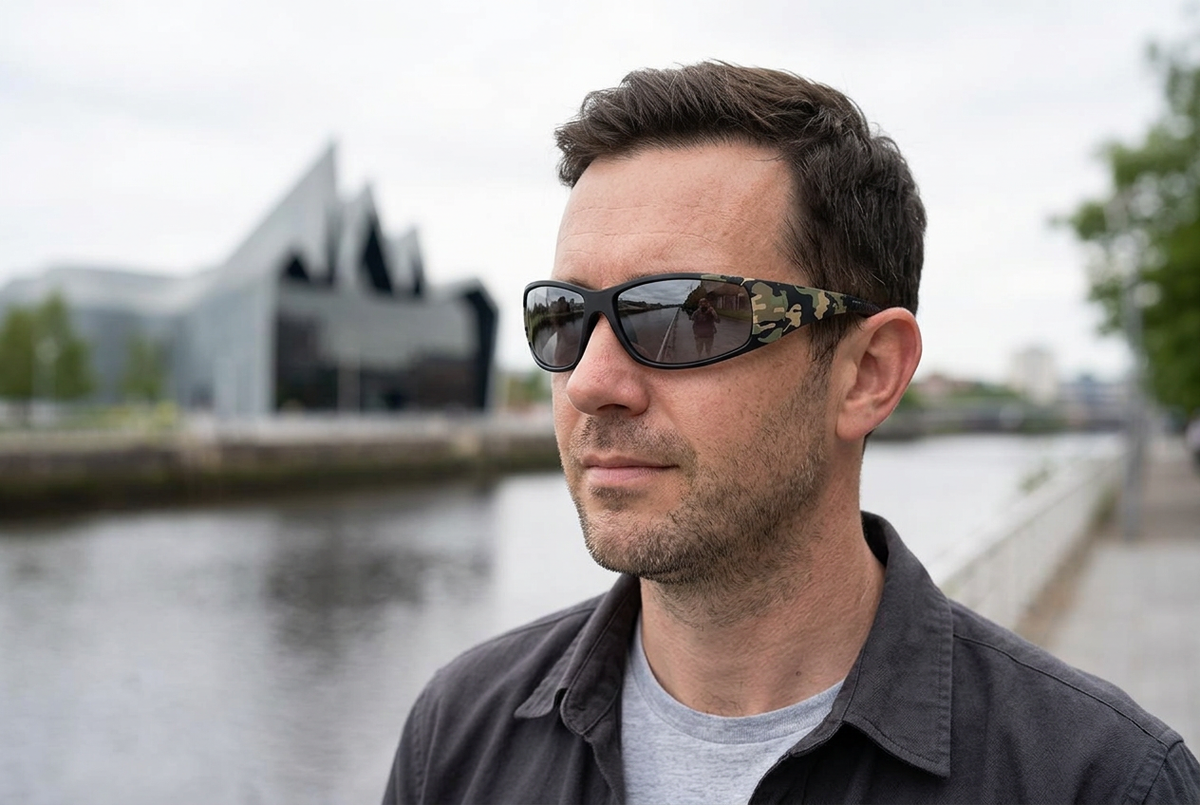
A camouflage temple introduces a different character to men’s sunglasses: outdoors-inspired, graphic and easy to pair with plain clothing. On a wraparound frame, the pattern is most noticeable in profile, while the dark front keeps the overall look restrained.
For a Glasgow riverside walk, try that detail with an olive overshirt, a stone-coloured T-shirt or a simple charcoal jacket. Keeping the rest of the outfit unpatterned gives the camouflage space without turning the combination into a costume.
The curved profile and broad temples are worth examining for fit as well as appearance. Try the frame through ordinary head movements and check how the sides sit against your head. A close-looking shape does not guarantee a secure or comfortable fit for everyone.
Here, army-inspired describes the styling only. Camouflage, a wraparound silhouette or a silver-grey lens finish does not establish military approval, ballistic protection or suitability for a particular sport. Those would require their own specific evidence.
Start with the pair you stop wearing
Before choosing a replacement, ask why your existing sunglasses stay in their case. Do they slide when you look down? Leave pressure around your ears? Feel too deep against your cheeks? Or do you simply dislike the way they look?
Those answers lead to different decisions. A style change will not necessarily fix a bridge problem, and a lighter listed weight will not automatically remove pressure from a narrow frame.
If the old pair is comfortable but visually dated to you, keep its dimensions as a starting reference. If it is uncomfortable, do not copy its measurements without considering where the trouble occurs.
Slipping is not always a reason for tighter arms
A frame needs an appropriate relationship with your nose as well as the sides of your head. If the bridge does not sit well, squeezing harder at the temples may introduce a second problem without resolving the first.
A moulded bridge has a fixed shape. Separate adjustable nose pads provide another fitting approach on designs that include them, but their presence alone does not guarantee comfort. Pad position and frame proportions still matter.
During a careful try-on, look down and turn your head gently. Notice whether the frame stays in place without your face tensing to hold it. Persistent slipping or pressure is a reason to reconsider the fit or seek professional adjustment, not to bend the frame yourself.
What spring hinges can, and cannot, change
Spring hinges allow the temples some outward movement beyond their normal opening position. That flexibility can accommodate movement and may reduce the rigid feeling of the arms in some fits.
They do not turn one frame width into a universal size. If the front is too narrow or the bridge sits poorly, spring hinges cannot be expected to solve it. Nor are they a promise that the frame will resist every knock.
Check the individual product description for hinge type. A metal-looking frame does not establish which hinge it uses, and a standard hinge is not automatically an uncomfortable choice.
Look at the temple length and the position of the curve behind the ear too. Where pressure occurs is more informative than deciding that every frame in a material category must feel the same.
Read weight alongside shape, not instead of it
A listed weight is useful for comparing products, but it cannot describe how that weight is distributed on your face. Bridge contact, overall width and temple shape influence the experience as well.
Compare lens width, bridge and arm length, plus total frame width where supplied. The lens-width figure measures one lens, not the complete front. Two frames with similar numbers may sit differently because their contours differ.
For men’s fashion sunglasses, this lets you keep the visual effect you want while being more selective. A defined rectangular outline does not have to mean the broadest frame available; a fine-rimmed look does not remove the need for a proper fit.
Beside the Clyde, separate glare from darkness
Bright conditions near water can make lens choices worth considering, but no location calls for the same tint every day. Cloud, shade and the direction you face all change the light during a walk.
Where a product specifies TAC polarised lenses, TAC refers to triacetate cellulose used in the lens construction. Polarisation is the feature intended to reduce certain reflected glare. It can be useful outdoors without eliminating every reflection or making the scene universally clearer.
Read the stated UV protection separately, along with the lens category and intended use. Neither the TAC name nor a dark appearance supplies the whole specification. A mirrored finish is another separate characteristic, not proof of polarisation.
Check screen readability with the lenses you choose, and remove sunglasses whenever they make it harder to see. The right pair for bright daylight is not automatically appropriate once the conditions become dim.
Prescription needs belong in the decision early
If you want to use a frame with prescription lenses, look for an explicit relensing or prescription-friendly statement and discuss the exact frame with an optician before buying for that purpose.
Your prescription, lens requirements, frame curvature and construction can affect feasibility. A larger or more curved design may introduce considerations that are not obvious from a front photograph.
Confirm the specifications of the replacement lenses themselves. The original lenses’ tint, polarisation and UV specification do not automatically transfer to a new set.
If you would rather keep wearing existing spectacles underneath, purpose-designed overglasses are a different option. Their internal fit must accommodate your particular glasses; they should not force the inner frame out of position.
A long walk is not a sports certification
Comfortable everyday sunglasses and activity-specific sports sunglasses have different selection criteria. Walking beside the river does not mean you need a sporting design, while cycling or running calls for checking suitability for that particular activity.
For sports use, consider stability, equipment compatibility and the manufacturer’s stated intended use. Do not infer impact protection from a wraparound appearance or flexible-looking material.
For a relaxed Glasgow afternoon, choose around ordinary movement and the light you expect, with room to put the pair safely away when it is no longer useful.
Let comfort be specific
Instead of asking for the most comfortable men’s sunglasses in the abstract, identify the bridge shape, width and temple behaviour that work for you. That makes comparison more meaningful than relying on a broad promise of all-day comfort.
Explore the men’s sunglasses collection at Missandtrendy, compare the individual specifications and give your fit requirements as much attention as the silhouette. The successful choice is the pair you can enjoy wearing, not just admire in the mirror.