
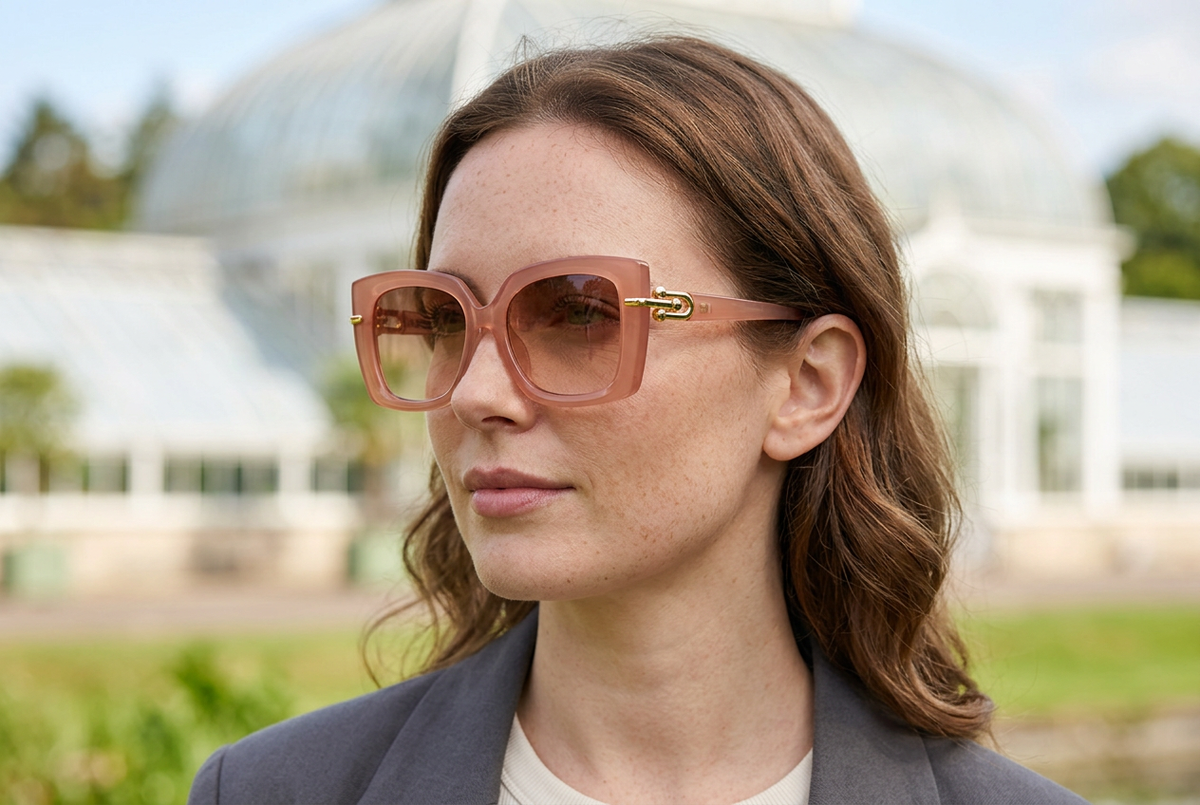
A statement frame makes a promise in a photograph: put these on and the outfit changes. Sometimes it delivers. Sometimes the shape you loved online spends more time being pushed back up your nose than being enjoyed.
Choosing women’s sunglasses is where those two stories meet. You can want a pronounced silhouette and still ask sensible questions about bridge fit, lens features and whether the frame can accommodate your prescription needs.
With Glasgow’s West End as our backdrop, this guide starts with a bold design and works through the decisions behind it. Browse the Missandtrendy women’s sunglasses collection for possibilities, then look beyond the first impression.
You like the shape. What is actually making the statement?
Imagine sunglasses worn with a simple coat on Byres Road. Is it their width that catches your eye, the depth of the lenses or the line sweeping towards the temples? Identifying that feature makes it easier to find an alternative if the first pair is not the right fit.
A broad, straight upper edge gives a different effect from an upswept corner. Deep rounded lenses create presence without the same angular emphasis. A thick rim can look assertive even when the overall frame is not especially large.
That means you do not have to choose the widest pair to get a bold look. If a design overwhelms your face or sits awkwardly, keep the feature you enjoy and try different proportions.
Women’s fashion sunglasses are most satisfying when the drama is intentional, rather than an accidental result of buying the wrong size.
When a bold frame feels wrong, diagnose the fit
It slips when you look down. Start with how the bridge sits, not a tighter grip from the temples. A moulded bridge has a fixed contour; adjustable nose pads offer a different fitting approach, but only on designs that actually include them. Neither guarantees compatibility with every face.
It presses at the sides. Check overall width where supplied and how the temples sit. Spring hinges allow some outward movement and may help accommodate movement, but they are not a substitute for an appropriately sized frame.
It touches your cheeks. Lens depth and the position of the frame both matter. A shallower design may preserve a strong brow line without the same lower-rim contact. Smiling is a useful part of checking this, not just looking straight ahead.
Use the measurements of a comfortable existing pair as a reference. Lens width, bridge and temple length describe different things; one lens-width number cannot tell you the width of the whole front. Seek professional fitting advice rather than bending a frame yourself.
TAC polarised lenses: useful features, separate questions
The lens description deserves as much attention as the silhouette. TAC stands for triacetate cellulose, a material used in laminated sunglass lenses. The term describes material construction; it should not be treated as a complete specification for protection or performance.
When a product is specified as having TAC polarised lenses, the polarising feature is intended to reduce certain reflected glare, such as glare from some horizontal surfaces. That can be useful outdoors, but it does not remove every reflection or guarantee the same experience in every setting.
UV protection is a separate check. Read the stated UV specification, lens category and intended use for the particular pair rather than assuming the TAC or polarised label supplies all that information.
To compare this feature specifically, explore women’s polarised sunglasses. Check how your chosen lenses work with screens you use, too: some lens and display combinations affect readability.
No lens material makes a pair indestructible. Follow the supplied care instructions and protect the lenses in a suitable case.
Love the frame but need different lenses?
Relensing can be worth exploring when a frame you enjoy is specifically described as prescription-friendly or suitable for replacement lenses. It offers the possibility of keeping the frame while discussing a different lens solution with an optician.
That is a starting point, not approval for every prescription. Frame size, curvature, construction and condition can affect what is feasible, alongside your prescription and the lenses you need. Ask an optician to assess the exact frame before buying it for that purpose or arranging replacement lenses.
Be clear about the finished specification you want. Replacement lenses do not automatically retain the original pair’s polarisation, tint or UV specification; confirm those features for the new lenses with the provider.
Relensing is also different from overglasses, which are designed to sit over existing spectacles. Choose the approach around your needs rather than treating the terms as interchangeable.
Let the setting change without changing your priorities
A statement pair can feel equally at home beside a plain knit near the Botanic Gardens or a tailored jacket for lunch around the West End. You do not need extra accessories to justify a frame with presence.
But the outfit is not the reason to keep tinted lenses on. Check the actual daylight and remove the sunglasses indoors or whenever they make it harder to see. Glasgow’s location or a particular season does not decide the appropriate lens for every day.
If your plans shift from a relaxed walk to a specific sport, reassess the eyewear as well. Sports sunglasses should be chosen for the activity and equipment involved, not simply because a fashion frame looks streamlined.
A statement worth making is one you can wear
Start with the line or proportion that appeals to you. Check the fit before excusing discomfort, read the lens specification without relying on a single label and ask an optician about relensing where relevant.
That leaves room for personality without giving up practical judgement. Explore women’s sunglasses at Missandtrendy to find a frame that looks distinctive and makes sense for the way you intend to wear it.